|
|
Article By Kyle Doyle - February 8th, 2008
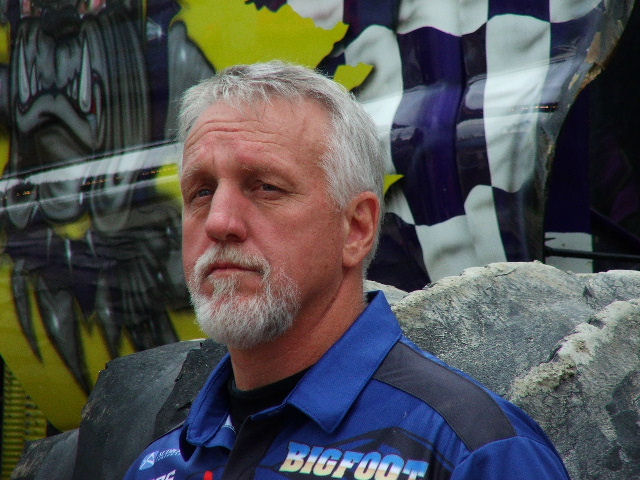
Jim Kramer. To a seasoned monster truck fan, the name says it all. It’s hard to imagine what the monster truck industry would be like without Jim’s contributions over the last 30-plus years. From the earliest days of the Bigfoot organization to the diverse and fast-paced industry that the monster truck community has grown into, Jim has been there all along, acting as a true ambassador of the sport, not just on behalf his team, but the entire industry. Within the sport, Jim is held in high esteem among his peers and competitors, and for good reason.
We live in a world that cherishes the most outlandish athletes, celebrities, and entertainment figures, and these days the monster truck industry is no exception. Thus, it is rare to find a person as influential, knowledgeable, respectable, and low-key as Jim in this sport. Even at the height of his driving career in the late 1980’s and early 1990’s, he was as cool and under-control as you could ask a person in his shoes to be. While some of today’s drivers may find it necessary to scream loudly into the microphone, throw their helmets, and jump around like caffeine-riddled children to garner additional applause, I don’t think you would ever find Mr. Kramer acting that way, even if he still drove today. You might say he is a blend of “humble” and “confident”.
Jim Kramer is still one of the industry's key figures, 30 years after he was it's top driver.
Jim has been a vital and integral part of the day-to-day operations at Bigfoot 4x4 for a very long time; many consider him to be every bit as important to the sport and its history as Bigfoot’s founder, Bob Chandler. I wish I could say I know Jim even better than I do, but what little I do know of him and his personality leads me to believe that he would just as soon shrug off the praises sung and the compliments paid, and get back to doing what he does best: make Bigfoot go. And go well. I must admit, as a young boy growing up in the Kansas City suburbs, my interest in monster trucks burned like a white-hot core inside of me. While most kids my age probably went to Arrowhead Stadium to watch Chiefs football games, I went to see the monster trucks. While most kids my age likely went to Kemper Arena to see the Blades play semi-pro hockey games, I went to see the monster trucks. It was at these shows, and through the graces of home videos and cable TV that I found my first “role model.” Yep, you guessed it. Although it may draw a chuckle from you readers (and I find myself smirking at it a bit myself), Jim Kramer really was a great role model for me as a young boy growing up. He always seemed like the good guy; he always said nice things about the people he was racing against; and, perhaps most impressive of all to my 7yr-old self, he always seemed to win!
I met Jim for the first time in 1992, and although I can guarantee you he will never remember my anonymous face in the crowd, I still can’t forget how it felt to finally meet him. Years later, as I began my monster truck career, what a realization it was that I was no longer in the Jim Kramer autograph line…I was essentially working right next to him! Since that time I’ve enjoyed several conversations with Jim, and I have always walked away from a chat with him feeling like I’ve learned something. He seems to have this way of looking at things from a totally unique point of view, and when he shares his thoughts I find myself saying to myself “Wow, I didn’t think of it that way!” Thus, as I pondered how to kick off my new editorial series here on The Monster Blog, I wondered what it would be like to get Jim’s take on some of the sport’s hottest issues, and then share that with all of you. I’m not sure if Jim has been approached a lot by the online monster truck community to grant interviews, but I would like to publicly express to him my gratitude for taking the time to share so much with me, and giving me leeway to share it with everyone else.
Kyle Doyle: Many feel the industry is in a state of turmoil right now. A major new series is on the horizon, sponsors are coming and going, drivers and crew are coming and going, promises are being made, things of that nature. What do you make of all of this? Is this all something to get worried or excited about, or is this just “another day on the job” for Jim Kramer?
Jim Kramer: I don’t think the industry is in a state of turmoil. True, major sponsorships on two fronts have had to pull away for financial reasons, but they were mainly team sponsors, not show sponsors. Dodge did help out with the Special Events series and Ford, at this time, is still with Live Nation, but most trucks in the industry don’t get to work for these people anyways. Drivers and crew have a way of shifting their alliances, but this is nothing new. I think it is happening a little more this year with the promise of a new series, but it’s still nothing to get excited about.
Its not uncommon to see Kramer working in the pits on a given weekend, seen here repairing a punctured tire.
KD: I think it is safe to say that the MLMT is probably one of the, if not THE hottest topic in the industry right now. A lot of hushed talk and speculation are going around in public, in the pits and behind closed doors. What is your impression of the MLMT up to this point, and do you think it will get off the ground?
JK: I would agree that the MLMT is the [hot] topic of the industry now, but there are still many unanswered questions. I think they are trying to keep everyone abreast of what’s happening, with the new show-date schedule and payouts, but I would really like to know what the TV package looks like; that’s something we can sell. I wish the MLMT all the luck in the world with this because the sport needs it. The sport needs better representation on TV than what it’s getting, and I know that the MLMT can deliver the excitement and cohesion a real race series can generate. Long tracks 3000ft or better, large jumps even on the faster backstretches, what’s not to like? These tracks promise to be drivers’ tracks, not just point-and-shoot formats we see all too often. Trucks will have to be set up differently for each track and sometimes for the race and freestyle events the same night. The drivers will be asked to show us what they really can do. Man, I wish I could drive again. I went to one of the MLMT’s 2007 races in Texas, and it was great. If it had been filmed, it would have made a great show. I also did my own exit poll with the fans leaving, and the response was terrific. Fans love the long track[s], large jumps, multiple turns, and the 100% race-oriented format. There was never a doubt who won or lost or why the race was won or lost. If done right, this series could put a new face on the sport. Also, the ability to spread out the freestyle obstacles worked well for fan “viewership”.
KD: The positive aspects of the MLMT taking off have been elaborated on greatly. But if the MLMT flounders, do you see this hurting the sport’s chance at becoming more of an established motorsport, as opposed to motorsports-entertainment?
JK: If the series takes off, great. If not, it is still a stepping-stone to the next format that may catapult it to the forefront of the motorsports industry. Who knows? Maybe seeing these trucks race isn’t what the public wants. I like to think it is, but do I know? Absolutely not. They may want large outdoor exhibitions of what these trucks can do. I would hate to think I would have to jump a plane every weekend, but if so we would have to think of a way to deliver or go by the wayside.
Kramer has been instrumental in mentoring new Bigfoot drivers, most notably of recent, Keith Sturgeon.
KD: One of the hallmarks of the Bigfoot team is reliability and consistency. The public perception of Team Bigfoot is that there have been a lot of changes in 2007, but sometimes public perception can be an overstatement of the way things really are. Could you fill us in on what has really changed in 2007, and to what degree it has affected how the team operates. What can you share with us about your 2008 plans, and what hopes do you have for the team in the coming year?
JK: Reliability and consistency is what we strive to achieve here at Bigfoot, and in 2007 we ran a new version of the big block Ford engine; we ran a Powerglide transmission that proved itself to us; we tried and found a sway bar that we have not been able to bend; and we have built a new u-joint we have not been able to break. We did this all on a new chassis- Bigfoot #16. We lost one of our greatest assets in the shop with Roy Hooser leaving, but our other people have stepped up and we are getting things done. We have initiated better tracking procedures on the parts we use on Bigfoot, better enabling us to know their failure rates so we can better maintain consistency. In 2008, we have axle and suspension mods on our minds. Bob also has a new chassis on his CAD program that I really hope gets built.
KD: Since the beginning of monster trucks, exhibitions (freestyle, essentially) have been an integral part of the sport. Crushing cars is the monster truck industry’s “hook”. It seems to me that no matter what the industry does, we will never be able to get away from the “car crushing” aspect. Do you see the destruction of vehicles and obstacles as a wall preventing monster trucks from becoming more “legitimate”? It could be argued that freestyle has become as popular if not more so than racing at the vast majority of monster truck events. What are your feelings towards this trend?
JK: I thought the cars would somehow fade away, but after 30-plus years they are still here. I think you build your tracks the way you want them then bury the cars behind a high-speed jump where they essentially don’t interfere with your race. As long as dads say to their kids “Did you see how that monster truck crushed those cars? WOW!” there will always be cars in the show format. Freestyle is a very popular part of a show, and I know I feel what most drivers feel: I wish I had a race truck for the race segment and a freestyle truck for the freestyle portion of the show. That’s why I mentioned earlier in the interview that teams might have to make special adjustments to their trucks for the freestyle event. The MLMT is the first promoter that is actually paying money for good performances. I have not seen their performance criteria, but I bet it will be interesting. The MLMT is a two-pronged event, and I think you will see contenders getting into this with mainly freestyle money in mind, although they still have to qualify well enough to make the show.
Kramer showing off with an early "reverser" move in this classic Bigfoot photo.
KD: A lot of “hard-core” fans look at the 1980’s and early 1990’s as the “golden years” of monster trucks, the “good ‘ole days” if you will, though many of these fans weren’t even old enough to really comprehend what was going on during that time period. As somebody who was not only there for it, but was arguably at nucleus of it all, do you look back on that time frame with any sort of nostalgia or romanticism? Or do you see an industry trying to find its way and deal with a meteoric rise to popularity?
JK: The early days of monster trucks were never boring. Anything you did with a truck was a new experience, from crushing taxi cabs in New York City to crushing 38 cars at one time to set a record in the hills of West Virginia. Promoters actually paid you what you were worth; novelty sales were handled mostly by yourself or for low rates by the venues; and you got the chance to win over throngs of people with the excitement of monster trucks. It was like being in a fight. The driver would beat up the trucks during a performance, and the trucks would beat up the drivers. The trucks eventually won and were built tougher than the drivers. That’s what brought around the designing of the tube chassis and nitrogen-charged-shock trucks starting in 1988. Overall, it was a great era to run a truck. The events were more low-key and fun, and it gave us time to sort out to try to take this form of entertainment and ultimately what configuration the vehicles should take on to really keep the thrill of monster trucks alive.
The more observant diehard fans still recognize their childhood hero crewing in the background at events from time to time. When spotted, Kramer is always willing to make a long-time monster truck fan's night by signing an autograph or two and taking a moment to talk about the early days of the sport.
KD: Is the monster truck industry better off in January of 2008 than it was in January of 1988 or 1998? Or do you feel we have taken one step forward and two steps backwards, on the whole?
JK: I think the industry on a financial basis as it concerns the truck owners was better off in the 80’s. The promoters make the lion’s share of the money generated by monster truck entertainment today. This could change for the betterment of the drivers if a national TV network would air monster truck shows and race events on a regular basis. More sponsors would come to the sport as a viable way to reach new clientele, and more team recognition would be afforded to the participants. Sponsor and team awareness would grow in the product-marketing sector of what is known as the motorsports world. Truck technology on the other hand is definitely moving forward with no slowdown in sight. If you would have asked me to jump a semi truck in the 80’s, I would have laughed at you; but now I’d ask what kind of run-up room I have and how long the shut-down area is and, of course, what does it pay?
KD: Okay, enough of all that now, let’s talk about the important stuff. While hard-core fans may live and breathe monster trucks 24-7, that typically isn’t the case for those actually working in the industry. Many of us prefer to not go home to walls full of monster truck pictures and memorabilia. The majority of celebrities, musicians, and motorsports personalities tend to develop hobbies and interests that are well outside the sphere of their working lives. Is that the case for you? What sorts of interests occupy your spare time?
JK: I really like doing things with my wife and kids. My daughter is married, so I’ve gained a son-in-law, and my son has a serious girlfriend, and we just have a lot of fun. We vacation together, and we will take advantage of the smallest reason to have a party of some sort. We listen to local bands and occasionally catch a concert or two when they travel to our area. My son has been a musician for 12 years and has gotten me interested in it. I don’t play a note of music but developed the hobby of customizing and repairing guitars and tube amplifiers. I own nine guitars and five tube amps. Sometimes I come back from a road trip and find four or five guitars or an amp that someone wants me to work on. It’s fun stuff.
The Jim Kramer hobby: customizing and repairing guitars.
KD: What’s on Jim Kramer’s music playlist these days?
JK: I like anything bluesy and good rock ‘n’ roll: Stevie Ray Vaughn, Eric Clapton, George Thorogood, Z.Z. Top, B.B. King and Muddy Waters, just to name a few.
KD: You and I talked briefly during lunch at the MTRA meeting in December, and you mentioned to me that after all these years of hard work and time away from home, you’d like to see the sport really turn into something before your hang up your hat. No matter how many people may try to express to you what they feel you’ve done to help the sport, at the end of the day do you feel that it’s all about how YOU feel you’ve helped the sport and what YOU feel you’ve accomplished, rather than public opinion?
JK: I’ve lived most of my life in the sport and [I] really wish that it would have progressed further. It is a great family entertainment format that has appeal to a broad spectrum of people – kids, moms and dads, off-road enthusiasts, drag race fans, or most anyone who likes their motors loud and their action fast. My first mission was to get the public interested in the sport, and all of our missions now are to keep them interested or to grow the sport. I will continue to try to heighten public awareness as to what we do as long as I continue to work in this field. I really want to see the industry grow for the betterment of all involved in it, especially the teams and team owners who make their living in it.
KD: How would you like current and future industry members and fans to look back on your career and what you’ve done? Is a “legacy” important to you at all?
JK: I am not a very sentimental guy. I probably only have three Bigfoot pictures in my home, and I have never kept a scrapbook of what I’ve done over the years. I have always lived my life in the NOW, not in the past. If people remember me for what I’ve done in the past, that’s great. It means that I must have done something right to make that kind of impression on them. For the record: I love this sport and would be honored to be remembered as someone who helped pioneer it.
A pioneer indeed. I would like to once again thank Jim for taking the time share some his thoughts, especially considering how busy the first quarter is for an operation like Bigfoot 4x4. Jim, I owe you lunch and a cold one.
- KD Email KD and let him know what you thought!!
------------------------------------------------------------------------------------------------- |
|